Got a burning question?
we’ve got answers.
We’re happy to answer it all.




ethical eggs
Our eggs
We believe our eggs taste so good because our pasture-raised hens live happy, healthy lives! Our girls’ fresh-air lifestyle is full of foraging and feasting on natural goodness, which shines through in every egg. If you’ve never cracked open a pasture-raised egg, your culinary life is about to change.
A hen’s age is the main factor that determines egg size. Young hens that are just beginning to lay tend to produce smaller eggs, and occasionally a few jumbos as well. To keep your cartons consistent, we do our best to grade out the eggs so you only get eggs of a certain size. Because our eggs are natural and not from a factory farm, you may see some variation in egg size.
Our price reflects our commitment to Conscious Capitalism and enables us to create long-term value with all of our stakeholders. We work with the best family farmers in the business, we believe they deserve fair pay for their hard work, and we want to pay them a competitive wage. We also have around 600 crew across our Egg Central Station and remote workforce who work hard every day to raise the standards. Our retail customers (like your local grocery store) need to run a profitable business to continue serving their local communities. And shareholders deserve a fair return on their investment. In fact, if you want to know more about our commitments to investors, take a look at our latest commitments, which we announced in December – it’s all available on our investor page.
While it’s true that a hen’s earlobe color will tell you what color their eggs will be, that’s not the reason behind the color. An egg’s color is determined by the breed. Most of our hens are Hy-line Browns — and it’s in their genetics to lay brown eggs.
All our farms are in a region of the U.S. we like to call the Pasture Belt, where pasture-raised eggs can be produced year-round. The Pasture Belt includes Kansas, Missouri, Kentucky, Arkansas, Indiana, Illinois, Ohio, Oklahoma, Tennessee, and West Virginia.
It’s like a four-leaf clover, but tastier! Double yolks usually come from young flocks that are just beginning to lay. Until the hens get the timing just right and learn how to lay, two eggs may merge together in the hen’s oviduct, meaning she’ll lay one large egg with two yolks hidden inside. Don’t be surprised if you see multiple eggs with double yolks in a single carton — they all came from the same young flock.
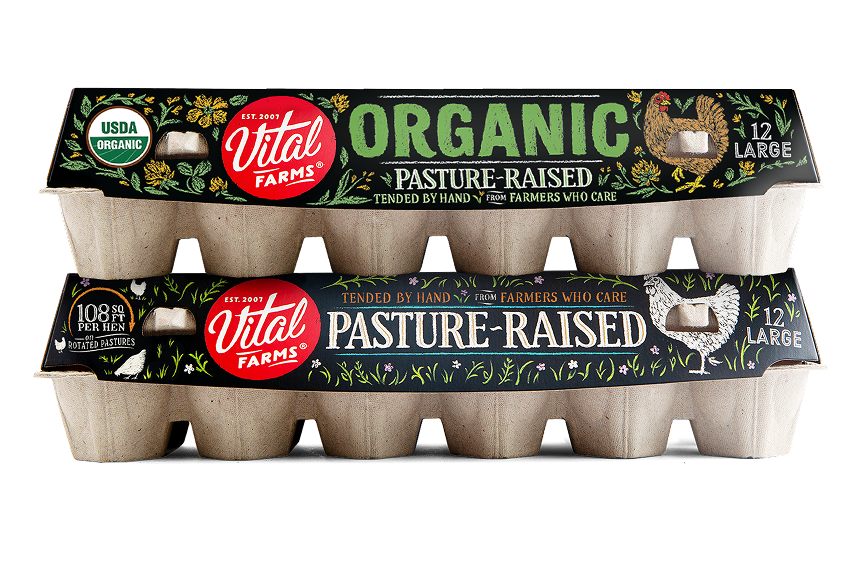
Pasture-raised eggs are laid by hens that can spend their days outdoors roaming the pastures as they please. Our hens enjoy at least 108 square feet of pasture each, with plenty of fresh air and sunshine year-round. This outdoor access gives the girls a lifestyle they deserve, with freedom to forage through rotated pastures, feasting on a natural buffet of grasses, bugs, and grub alongside their essential feed.
The girls roost together in the barn overnight, where they feel safe from predators. In certain situations, when the girls’ health and safety are at risk, we may need to keep them temporarily indoors.
We make these decisions based on state and local guidance, as well as guidance from our veterinary partners and Certified Humane®, which audits our pasture-raised animal welfare practices. These situations are only in the event of a significant risk to the girls, such as a weather or health emergency.
Our pasture-raised standards haven’t changed — they’ve just scaled across hundreds more family farms and communities. But across our business, the standards actually have changed — they’ve gotten higher. For example, our egg washing and packing facility in Springfield, Missouri, has continually reduced waste and supported more jobs in the community. We’re also scaling more regenerative farming practices across all of our farms, which we committed to in 2023. Read more about how we’re raising the standards in our latest impact report.
We went public in 2020, which means anyone can buy VITL shares. BlackRock and other investment groups own shares. So do our crew members, who receive annual grants regardless of title or seniority, from our most junior team members to our CEO. If you want to better understand some of our core financials, check out our investor page. It’s all open to the public.

The Forage Blog
3 Things You Didn’t Know About Double Yolks
So you found a double yolk?! To us, that's like finding a four-leaf clover, but tastier!
The girls
Our birds have always had year-round access to pastures with at least 108 square feet of pasture per bird. They’re happier and healthier when they spend time outside, and it allows them to express their natural behaviors, but we don’t force them out there. When the hens first arrive at the farms, we train them to go on pasture. Then every morning when the barn doors are opened, they know they can head out on their own time. The easiest way to understand this is in human terms — we’re happier and healthier when we get time outside, but it would create a lot of stress if someone was forcing us out there. It’s similar for the hens.
Most of our girls are Hy-line Browns.
We take many steps to ensure the health and safety of the girls. In fact, we have an entire team dedicated to supporting our farmers through weekly phone calls, monthly in-person visits, quarterly meetings, a seasonal newsletter, and a bi-annual survey. We provide guidance on care for the girls in all of these touchpoints.
On all farms, we take measures to proactively prevent predators and pecking.
Because the risk of predation is highest at night, our girls are taught from a young age to come indoors before sunset. We also regularly patrol our farms and use harmless countermeasures (like dummy owls!) to keep aerial predators at bay.
To protect the girls from pecking each other, we follow an industry-standard practice of dulling the tips of their beaks with an infrared treatment. Read more about beak trimming from Certified Humane®, one of our auditors, here.
Finally, we work with an external veterinary partner who visits farms regularly with our farm support crew and is available on an on-call basis. Their services help educate our crew and quickly aid farmers in need.
They go outside! Our girls live in warmer-weather states (in an area we like to call the Pasture Belt) where the winters are mild. Day in and day out, our girls freely forage for fresh grasses, seeds, and protein-packed critters.
Avian influenza (HPAI) is a virus that occurs in birds. Laying hens can contract HPAI when migratory waterfowl pass over farm areas and leave droppings containing the virus. HPAI cases typically happen in the spring and fall when wild birds migrate. Occasionally, some of our farmers will house their hens in barns to protect them HPAI outbreaks. Read more about HPAI and get updates on the status of our farms here.
Vital Farms began with one small family farm and a mission to bring ethically produced food to the table. Over the years, we believe we’ve played an important role in improving the lives of people, animals, and the planet by prioritizing our stakeholders — farmers and suppliers, crew members, communities and the environment, customers and consumers, and stockholders — and treating them as partners. We partner with over 600 farmers who share our passion for animal welfare and sustainable farming practices.
Starting when the girls arrive at one of these farms at about 17 weeks of age, we think they live just about the best life possible for a laying hen. They enjoy acres of open pasture, fresh green grass, and the freedom to come and go from comfortable barns as they please. But farming is not always as straightforward as the picture postcard of hens roaming in fields of flowers.
While we’ve prided ourselves in never taking the easy way out and in doing what we can to change our small corner of the farming world whenever we see the opportunity, there are certain biological and economic realities that are bound to collide. As the amount and quality of eggs our hens lay naturally decline with age, there comes a point when the hens can no longer produce eggs in an economically viable way for our farm partners.
In our early days, when we had just a couple of farm partners located near urban areas, we would place an ad on Craigslist and find homes for our retiring ladies with backyard farmers. Today, for several reasons including current FDA restrictions, that method no longer makes sense.
So, when the time comes for these laying hens, our farmer partners have little choice but to retire their flock. This typically happens either through an acceptable method of euthanasia or by selling them to pet food companies, which we believe helps make use of this precious resource. We consider the end of our hens’ lives as sacred as the rest of their time with us. We’ll continue to advocate for any viable alternatives to a hen’s post-laying life that are sustainable for our farm partners, the hens, and communities at large.
Because male chicks will not grow to become egg-laying hens, it’s the industry norm for hatcheries to identify male chicks upon hatch and euthanize them using methods approved by the American Veterinary Medical Association (AVMA) guidelines.
At Vital Farms, we’re committed to improving the lives of animals through food. In late 2026, we plan to adopt in-ovo sexing technology in collaboration with our primary hatchery supplier, Hy-Line North America.
Hy-Line North America has installed Cheggy technology developed by the German company, AAT, which uses a safe, non-invasive scan to determine whether the developing chick is male or female. This determination occurs before the embryo can feel pain, and the male eggs are prevented from developing further — allowing hatcheries to significantly reduce the number of male chicks that hatch.
The birds hatched after in-ovo sexing will begin arriving on farms in early 2027, and by 2028, we anticipate that the majority of our hens will have come from this process. While not all hatcheries in our network have adopted the technology yet, we’re hopeful that taking this step will help inspire broader change across the industry.
We are committed to actively following the latest developments of in-ovo sexing technology. By dedicating ourselves to raising the standards of our animal welfare practices, we can continue to bring ethical food to the table while better serving the long-term priorities of all our stakeholders.
To protect the girls from pecking each other, we follow an industry-standard practice of dulling the tips of their beaks with an infrared treatment. This process helps ensure they don’t hurt themselves or one another. You can read more about beak trimming from Certified Humane®, one of our auditors, here.
As you would expect from our farmers, they frequently and thoughtfully monitor the health of their hens. There are two primary reasons our farmers bring their hens inside full-time. The first is to keep them safe from extreme weather. The second is to protect them from seasonal health issues, such as avian influenza. These decisions are often mandated or recommended by individual states, and implementation varies by location. In either case, the girls go back outside as soon as it’s safe to do so.
The case is over and we got the win we’ve been fighting for. The plaintiffs agreed to drop their claims, and we didn’t pay them anything. It’s a huge victory for us. We defended ourselves in this case because we believe in what we’re doing, we know we’re raising the standards, and we’ve got the receipts to back it up. It’s great to see that validated by the outcome in this case.

Our farms
Ready to join our flock? Click here to learn more about becoming a Vital Farmer.
The company
We have explored many alternatives to corn and soy, including fish-based feed and black soldier fly larvae. However, we’ve found that these alternatives have tradeoffs, such as taste and sourcing challenges that would drive up costs for both the farmers in our network and the consumers who purchase our eggs. Our team continues to explore alternatives that can scale with our growing network of farms.
Everything a hen eats affects her yolk color. Our hens’ diet consists of what they forage from the pasture each day, alongside a nutritionally dense essential feed to supply the protein and energy they need to roam and lay regularly.
Out on pasture, they’re snacking on grasses and insects, which creates variation, while natural paprika and marigold are added to their essential feed to help support a richer, deeper color in a consistent way.
The reality of pasture-raised farming is that yolks naturally vary depending on what hens eat day to day and season to season. In the summer to early fall, the girls tend to eat less due to the warmer temperatures. In the winter, they tend to eat more to stay warm. We like to lean in and embrace this variance. Seasons and diets change, and our yolks reflect that.
A combination of a foraged diet and essential feed helps our pasture-raised laying hens meet their nutritional needs. The girls spend their days foraging in the pastures, seeking out native and seasonal grasses, pecking for their next grasshopper, or digging up worms.
Alongside their pasture snacks, they receive an essential feed that consists primarily of corn and soybean meal. The nutritional density and composition of the feed provide the protein and energy our hens need to lay regularly and roam the pasture. The feed also contains paprika and marigold, which, along with their pasture snacks, help the hens produce eggs with deep orange yolks.
This feed is developed by an animal nutritionist to ensure the girls receive all the nutrients they need to support their health, active lifestyles, and overall well-being.
Certified Humane® is a third-party animal welfare organization that certifies our pasture-raised egg practices. Certified Humane® standards are set by a committee of renowned animal scientists, veterinarians, and researchers. Each of our farms undergoes an extensive application, inspection, and verification process each year to ensure that we meet or exceed all of the Certified Humane® standards for pasture-raised laying hens. We’re proud to carry the Certified Humane® seal on all of our pasture-raised cartons. Read more about Certified Humane® standards for hens and other animals on their website.

We’ve got a team of real folks (seriously, no bots!) here to answer anything you’re curious about.